An Introduction
Every country has its own popular culture, consisting of legends and myths that are passed from generation to generation by word of mouth through storytelling. Let’s say that years ago your ancestors saw a creature into the woods and thought it was a monster. They told this story to the neighbors, who told it to their friends, who told it to their family members. From the beginning to the end, as the telephone game, the story changed completely: that monster, who had one eye, now has five, and instead of one leg now has four. This horrify creature changes its forms like a chameleon changes its colors. This story had huge repercussion through the time so that, nowadays, everybody from your country knows about it, becoming part of its culture. That’s what we call a folktale.
In 1928, a Russian formalist and folklorist called Vladmir Propp published his work Morphology of the Folktale, a study of 100 fairytales¹ from his country which purpose was to observe similarities and differences among them. During his analyzes, he realized that all those fairytales had two structures: one consisting of variable elements, such as the name of the characters and their attributes; the other one contained elements that were constant during the narration related to the actions conduced by the characters. These actions, he noticed, were essential to the plot development in the sense that, without them, important changes would not happen. Propp called the constant structure Functions, and they are our subject of discussion today.
It is always good to remember that Functions are actions that change the course of the narrative. If an action doesn’t change anything, it is not a function. Vladimir Propp observed 31 constant functions² in all those 100 fairy tales he studied. The first one he points out, which infuses the tension of the story, is called absentation. A family member is absent from home, maybe on a trip, leaving the family alone without protection in case of danger. This function is very important because the absence of a protector gives space for all kinds of unfortunate events to the ones left behind. Another important function is trickery of a villain, who, by persuasion or magic powers, gets the trust of the unprotected family and makes them do what he wants. By this, the villain can harm the victims in different ways: by planning their murder, their abduction… There is no doubt that these poor people need some help, and they will have it through the actions of a hero, most of them turning out to be functions too. Notice that only by pointing these two functions it is easy to understand why they are so important to the narrative: without them, the story wouldn’t have its turning points. Although Propp found 31 functions in his material of studies, he makes clear that some folktales don’t have all of them, sometimes only a few or even featuring them in an implied manner and in different order. He also remembers that the absence of all the 31 functions is not impossible, but rare.
Let’s make it simpler by taking Sleeping Beauty as an example, for it is known all over the wo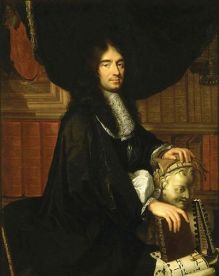 rld. Remember: this story has different versions and was derived from pre-existing folktales. It is basically the same process your ancestors’ neighbors and all those other people used to create the fairytale from your country. The version we are discussing, then, is by French author Charles Perrault. The words highlighted in bold are the name of the functions given by Propp. Observe how they change the course of the character’s future.
Above, Portrait of Charles Perrault, by Philippe Lallemant
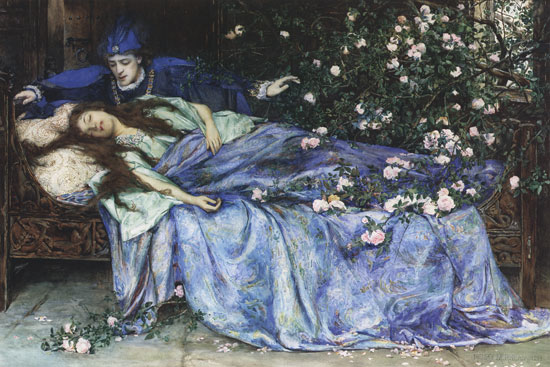 Above, SLEEPING BEAUTY, BY HENRY MEYNELL RHEAM
Once upon a time a baby Princess who was having a party in which seven fairies were invited to be her godmothers. An evil fairy got very angry because she wasn’t invited, so she created a spell: by the age of 16th, the Princess would prick her finger to a spinning wheel and die. One of the seven fairies who hadn’t given a present yet altered the bad lady’s prophecy, so the Princess would not die, but would fall asleep and be awaken by a romantic kiss of a Prince. Sixteen years passed, and The evil fairy learned about the absentation of the King and Queen from the Kingdom. That was the perfect moment for her to put in practice her villainy predicted by her spell. By trickery, she made the Princess prick her finger and then she fell deep asleep. The good fairy who altered the evil spell put everybody in the kingdom to sleep until Sleeping Beauty woke up, which wasn’t something too nice to do, but she did it anyway. She was very smart and made sure to surround the castle by trees and thorns so the Princess wouldn’t be disturbed by anyone. A hundred year passed when something amazing happened: the mediation of a brave prince who came to save her. He got guidance by a Labrador, who confirmed the story of a Princess who sleeps for years, and who will only wake up when a Prince gives her a kiss. It is the beginning counter-action of the prince, whose departure is soon to cross the thorns and all the danger to save the Princess. His victory, of course, is certain. According to the reverse of the spell by the good fairy, the Prince kissed the Princess. The liquidation of the damage, then, is completed, and the Princess and everybody else from the Kingdom wake up from this crazy and long sleep. Their wedding is secretive, not like the Disney one. When the Prince is about to become king, he brought the Princess and their two children to his kingdom. The queen, who was an Ogress, planed to kill the children and the ex Sleeping Beauty when her son was absent. The king returns just in time to rescue his family and pursuit his mother, whose punishment is her death. Well, she deserved it because she wanted to cook the children! The end.
In Sleeping Beauty story, not all the functions are present and their order of appearance is not quite the same. We have to have in mind that all the functions present in the fairytale, thought, contribute to the narration’s changes.
Macunaíma is a Folktale written by Brazilian author Mário de Andrade during Modernism. One of the artist’s intention during that time was to bring back some of the country’s popular culture and recreate Brazil. This way, by legends and myths, he gave shape and life to the character of his novel, an anti hero³ who represents the Brazilian people from beginning of 20th century. We are going to analyze in which way Macunaíma’s author followed the traditional structure of the classic folktales pointed by Propp.
We hope this little explanation was enjoyable for you. Next week we will introduce Mário de Andrade, his biography and work. As we get prepare, here is a question: could you tell us what is your favorite fairytale and why?
GOOD TO KNOW
Below are all the 31 Functions pointed out by Vladimir Propp in his Morphology of the Folktale. Notice that we could talk about all the functions in rich details, but here we will just briefly describe them in a didactic way:
- ABSENTATION of a member of the hero’s family who is its protector, mostly the father, and so the tension starts.
- INTERDICTION of any kind to keep the hero safe.
- VIOLATION of INTERDICTION, causing negative consequences.
- RECONNAISSANCE by the villain, who tries to find information of where the victim is. For example, if the King was absent, the villain will try to find where his children were.
- DELIVERY of the information to the villain.
- TRICKERY of the villain, who can use persuasion or magic powers to get the victim’s trust.
- COMPLICITY of the victim to the villain.
- VILLAINY or LACK of the victim. The villain now can and will harm or abduct his victim,
- MEDIATION of the hero, who notices the victim’s absence.
- BEGINNING COUNTER-ACTION, when the hero takes actions to save the victim.
- DEPARTURE of the hero to the rescue’s adventure.
- FIRST FUNCTION OF THE DONOR, a magical agent or helper who will test the hero’s’ abilities to prepare him to receive a magical help
- HERO’S REACTION to the donor’s actions. He may/may not overcome his test.
- RECEIPT OF A MAGICAL AGENT by the hero.
- GUIDANCE of the hero to where the victim is.
- STRUGGLE between hero and villain.
- BRANDING, that is, the hero is marked by a scar, by an object received (ring, scarf) or any other brand.
- VICTORY of the hero.
- LIQUIDATION of the damage.
- RETURN of the hero travels.
- PURSUIT of the hero by an adversary.
- RESCUE of the hero.
- UNRECOGNIZED ARRIVAL of the hero to his home.
- UNFOUNDED CLAIMS of a false hero who wants his reward.
- DIFFICULT TASK to find out who is the real hero.
- SOLUTION, when the hero accomplishes a difficult task.
- RECOGNITION of the hero by his branding.
- EXPOSURE of the false hero.
- TRANSFIGURATION of the hero, which can be by wearing new clothes or by magical powers (e.g. to transform him from an animal, result of the branding, to a prince.)
- PUNISHMENT of the villain.
- WEDDING of the hero.
Notes:
- Fairytale is synonymous of Folktale.
- See Good to know section for a brief explanation of the 31 functions.
- A character whose attributes don’t follow the traditional characteristics of a hero is calledanti hero.
Bibliography:
Perrault, Charles. (2011) The Sleeping Beauty and Other Tales. The Planet.
Propp, Vladimir. (2010) Morphology of the Folktale. University of Texas Press: Texas.
 oticrature