Mário de Andrade

The Man Who Reinvented Brazil


Mário de Andrade is a name that follows me for a very long time. Once at school, back to my 1st grade, I was asked to go to Mário de Andrade Publish Library to do a research. When you are a kid, every place that has a person’s name is very intriguing. You first thing that the name is from a politician, or a doctor who donate a lot of money to the City Hall, or an important person from history, a warrior maybe. I though that Mário de Andrade was a mayor from the past, but never though, until probably high school, that he was much more important than that: he was the man who reinvented Brazil.    

Opposite of what you certainly think, Andrade didn’t start his artistic career as an author. In fact, he never had formal education in literature. He was a prodigious pianist as a little boy and studied music instead, since this was his passion. He was, though, an autodidact in history, arts and poetry and had mastered the French language, getting in touch with works of Rimbaud and other poets from symbolism. For certain, that wasn’t an easy job for a little boy who was born at the end of the 18th century, in 1893. Therefore, even while studying music, he was already producing his own poems without pretensions of being the great author he turned out to be.

At this point, you are probably thinking why is the public library from Araraquara, my hometown, named after Mário de Andrade. It is not only because he is one of – or maybe the – best author from 20th century in Brazil, but because he wrote one of his masterpieces there (Macunaíma), in a farmhouse his family owned. He lived most of his life in São Paulo, a big city which was one of his poem themes, but in 1913 he moved to this countryside property after his brother died in an accident during a soccer game. He abandoned, then, his music studies, and when he was finally prepared to go back to his hometown he could no longer play piano, as he developed a problem on his hands, which trembling very often. However, he didn’t abandon his passion for music and became a teacher. At the same time, he showed a bigger interest in literature than he ever had. He published his first work in 1917, a collection of poems called There is a drop of blood in each poem under the pseudonym Mário Sobral. This work has vestige of Brazilian culture, although with strong French influence, and even though didn’t have the repercussion he expected, he kept working on his writings and researches about the Brazilian popular culture. During that time, he met a group of young artists who were interested in the European Modernism. They created the Group of Five, composed by the poets Mário de Andrade, Oswaldo de Andrade and Menotti del Picchia and the artists Tarsila do Amaral and Anita Malfati. Together, they organized the most important artistic event of vanguard in Brazil: The Week of Modern Art, which we will discuss further soon.

Mário was not only a poet, college professor and musicologist, but also novelist, critic and, of course, an art historian. His contributions to the record of Brazilian popular culture is immense and is not only visible in his literary work. In 1935, during an unstable political moment in Brazil, Andrade was able to create a unified Department of Culture in São Paulo with Paulo Duarte, a writer and archaeologist. One thing Andrade really wanted to do while funding director was to conquer and disseminate the Brazilian culture throughout the country. He expanded his work in folklore and folk music, bringing also his collection of recordings to the Department. Cultural and demographic research was, then, one among several important works he had done. In 1938, Paulo Duarte was exiled and Andrade resigned his position at the department, moving to Rio de Janeiro, where he would be a college professor. In 1941, he went back to São Paulo to take the position as funding director at the Department of Culture back, but he wasn’t as enthusiastic as he was before. Four years later, Andrade died of heart attack at the age of 52. 

During basically all his life, Andrade’s work wasn’t publicized as it should have been, for he had several divergences to the govern of president Getúlio Vargas. But after 1955 with the publication of Complete Poems his name could finally be canonized.

As we could see, Mário de Andrade is a national hero who not only helped bringing the artistic vanguard in vogue to his country, but also contributed to the reinvention of Brazil, with all his research about popular culture and its use into his writing work. Macunaíma is the best example, which, as a reminder, we will discuss very soon. Talking about Macunaíma, if you already read it or are reading it, what are your impressions so far?


About Araraquara

Araraquara is a green and beautiful college town. We call it Morada do Sol (Where the Sun lives) because it is very sunny and hot mostly all the time. There are also lots of folktales there, and I want to tell you the one about the snake.

A baby once was rejected by his mom and thrown into a river in front of one of the oldest churches of the city to die. This baby, then, becomes a snake, who lives underground the church. Every time it moves, it breaks a piece of the church, which was never finished. To protect the population against the snake, it was built a sculpture of an eagle, who supposedly protects the city. This is one among other versions of this folktale.


Good to Know


English Translations of Mário de Andrade:

  1. Andrade, Mario de. (1933) Fraulein. Trans. Marharet Richardson Hollingsworth. Macaulay, New York.
  1. Fraulein (Amar, Verbo Intransitivo). Trans. Margaret 1933.
  1. Popular Music and Song in Brazil. 1936. Trans. Luiz Victor Le Cocq D’Oliveira. Sponsored by the Ministry of State for Foreign Affairs of Brazil: Division of Intellectual Cooperation. Rio de Janeiro: Imprensa Nacional, 1943.
  1. Hallucinated City (Paulicea Desvairada). Trans. Jack E. Tomlins. Nashville: Vanderbilt UP, 1968.
  1. Macunaíma. Trans. E.A. Goodland. New York: Random House, 1984.
  1. Brazilian Sculpture: An Identity in Profile/Escultura Brasileira: Perfil de uma Identidate. Catalog of exhibition in English and Portuguese. Includes text by Mário de Andrade and others. Ed. Élcior Ferreira de Santana Filho. São Paulo, Brazil: Associação dos Amigos da Pinateca, 1997.


Published Works in Brazil 

  1. Há uma Gota de Sangue em Cada Poema, 1916
  2. Pauliceia Desvairada, 1922
  3. A Escrava que não É Isaura, 1925
  4. Losango Cáqui, 1926
  5. Primeiro Andar, 1926
  6. O clã do Jabuti, 1927
  7. Amar, Verbo Intransitivo, 1927
  8. Ensaios Sobra a Música Brasileira, 1928
  9. Macunaíma, 1928
  10. Compêndio Da História Da Música, 1929 (Reescrito Como Pequena História Da Música Brasileira, 1942)
  11. Modinhas Imperiais, 1930
  12. Remate De Males, 1930
  13. Música, Doce Música, 1933
  14. Belasarte, 1934
  15. O Aleijadinho de Álvares De Azevedo, 1935
  16. Lasar Segall, 1935
  17. Música do Brasil, 1941
  18. Poesias, 1941
  19. O Movimento Modernista, 1942
  20. O Baile das Quatro Artes, 1943
  21. Os Filhos da Candinha, 1943
  22. Aspectos da Literatura Brasileira 1943
  23. O Empalhador de Passarinhos, 1944
  24. Lira Paulistana, 1945
  25. O Carro da Miséria, 1947
  26. Contos Novos, 1947
  27. O Banquete, 1978 (Editado por Jorge Coli)
  28. Dicionário Musical Brasileiro, 1989 (editado por Flávia Toni)
  29. Será o Benedito!, 1992
  30. Introdução à estética musical, 1995 (editado por Flávia Toni)


Bibliography:

Andrade, Mário de. Macunaíma. Trans. E.A. Goodland. New York: Random House, 1984.

___ Macunaíma. MediaFashion: São Paulo, 2008.

Morphology of The Folktale, by Vladimir Propp

An Introduction


Every country has its own popular culture, consisting of legends and myths that are passed from generation to generation by word of mouth through storytelling. Let’s say that years ago your ancestors saw a creature into the woods and thought it was a monster. They told this story to the neighbors, who told it to their friends, who told it to their family members. From the beginning to the end, as the telephone game, the story changed completely: that monster, who had one eye, now has five, and instead of one leg now has four. This horrify creature changes its forms like a chameleon changes its colors. This story had huge repercussion through the time so that, nowadays, everybody from your country knows about it, becoming part of its culture. That’s what we call a folktale.

In 1928, a Russian formalist and folklorist called Vladmir Propp published his work Morphology of the Folktale, a study of 100 fairytales¹ from his country which purpose was to observe similarities and differences among them. During his analyzes, he realized that all those fairytales had two structures: one consisting of variable elements, such as the name of the characters and their attributes; the other one contained elements that were constant during the narration related to the actions conduced by the characters. These actions, he noticed, were essential to the plot development in the sense that, without them, important changes would not happen. Propp called the constant structure Functions, and they are our subject of discussion today.

It is always good to remember that Functions are actions that change the course of the narrative. If an action doesn’t change anything, it is not a function. Vladimir Propp observed 31 constant functions² in all those 100 fairy tales he studied. The first one he points out, which infuses the tension of the story, is called absentation. A family member is absent from home, maybe on a trip, leaving the family alone without protection in case of danger. This function is very important because the absence of a protector gives space for all kinds of unfortunate events to the ones left behind. Another important function is trickery of a villain, who, by persuasion or magic powers, gets the trust of the unprotected family and makes them do what he wants. By this, the villain can harm the victims in different ways: by planning their murder, their abduction… There is no doubt that these poor people need some help, and they will have it through the actions of a hero, most of them turning out to be functions too. Notice that only by pointing these two functions it is easy to understand why they are so important to the narrative: without them, the story wouldn’t have its turning points. Although Propp found 31 functions in his material of studies, he makes clear that some folktales don’t have all of them, sometimes only a few or even featuring them in an implied manner and in different order. He also remembers that the absence of all the 31 functions is not impossible, but rare.  

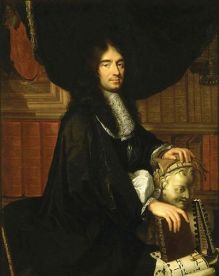
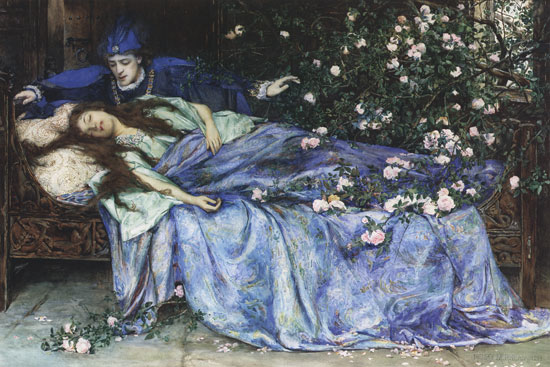
Let’s make it simpler by taking Sleeping Beauty as an example, for it is known all over the world. Remember: this story has different versions and was derived from pre-existing folktales. It is basically the same process your ancestors’ neighbors and all those other people used to create the fairytale from your country. The version we are discussing, then, is by French author Charles Perrault. The words highlighted in bold are the name of the functions given by Propp. Observe how they change the course of the character’s future.

Above, Portrait of Charles Perrault, by Philippe Lallemant
Above, SLEEPING BEAUTY, BY HENRY MEYNELL RHEAM

Once upon a time a baby Princess who was having a party in which seven fairies were invited to be her godmothers. An evil fairy got very angry because she wasn’t invited, so she created a spell: by the age of 16th, the Princess would prick her finger to a spinning wheel and die. One of the seven fairies who hadn’t given a present yet altered the bad lady’s prophecy, so the Princess would not die, but would fall asleep and be awaken by a romantic kiss of a Prince. Sixteen years passed, and The evil fairy learned about the absentation of the King and Queen from the Kingdom. That was the perfect moment for her to put in practice her villainy predicted by her spell. By trickery, she made the Princess prick her finger and then she fell deep asleep. The good fairy who altered the evil spell put everybody in the kingdom to sleep until Sleeping Beauty woke up, which wasn’t something too nice to do, but she did it anyway. She was very smart and made sure to surround the castle by trees and thorns so the Princess wouldn’t be disturbed by anyone. A hundred year passed when something amazing happened: the mediation of a brave prince who came to save her. He got guidance by a Labrador, who confirmed the story of a Princess who sleeps for years, and who will only wake up when a Prince gives her a kiss. It is the beginning counter-action of the prince, whose departure is soon to cross the thorns and all the danger to save the Princess. His victory, of course, is certain. According to the reverse of the spell by the good fairy, the Prince kissed the Princess. The liquidation of the damage, then, is completed, and the Princess and everybody else from the Kingdom wake up  from this crazy and long sleep. Their wedding is secretive, not like the Disney one. When the Prince is about to become king, he brought the Princess and their two children to his kingdom. The queen, who was an Ogress, planed to kill the children and the ex Sleeping Beauty when her son was absent. The king returns just in time to rescue his family and pursuit his mother, whose punishment is her death. Well, she deserved it because she wanted to cook the children! The end.

In Sleeping Beauty story, not all the functions are present and their order of appearance is not quite the same. We have to have in mind that all the functions present in the fairytale, thought, contribute to the narration’s changes.

Macunaíma is a Folktale written by Brazilian author Mário de Andrade during Modernism. One of the artist’s intention during that time was to bring back some of the country’s popular culture and recreate Brazil. This way, by legends and myths, he gave shape and life to the character of his novel, an anti hero³ who represents the Brazilian people from beginning of 20th century. We are going to analyze in which way Macunaíma’s author followed the traditional structure of the classic folktales pointed by Propp.

We hope this little explanation was enjoyable for you. Next week we will introduce Mário de Andrade, his biography and work. As we get prepare, here is a question: could you tell us what is your favorite fairytale and why?


GOOD TO KNOW


Below are all the 31 Functions pointed out by Vladimir Propp in his Morphology of the Folktale. Notice that we could talk about all the functions in rich details, but here we will just briefly describe them in a didactic way:


  1. ABSENTATION of a member of the hero’s family who is its protector, mostly the father, and so the tension starts.
  2. INTERDICTION of any kind to keep the hero safe.
  3. VIOLATION of INTERDICTION, causing negative consequences.
  4. RECONNAISSANCE by the villain, who tries to find information of where the victim is. For example, if the King was absent, the villain will try to find where his children were.
  5. DELIVERY of the information to the villain.
  6. TRICKERY of the villain, who can use persuasion or magic powers to get the victim’s trust.
  7. COMPLICITY of the victim to the villain.
  8. VILLAINY or LACK of the victim. The villain now can and will harm or abduct his victim,
  9. MEDIATION of the hero, who notices the victim’s absence.
  10. BEGINNING COUNTER-ACTION, when the hero takes actions to save the victim.
  11. DEPARTURE of the hero to the rescue’s adventure.
  12. FIRST FUNCTION OF THE DONOR, a magical agent or helper who will test the hero’s’ abilities to prepare him to receive a magical help
  1. HERO’S REACTION to the donor’s actions. He may/may not overcome his test.
  1. RECEIPT OF A MAGICAL AGENT by the hero.
  2. GUIDANCE of the hero to where the victim is.
  3. STRUGGLE between hero and villain.
  4. BRANDING, that is, the hero is marked by a scar, by an object received (ring, scarf) or any other brand.
  5. VICTORY of the hero.
  6. LIQUIDATION of the damage.
  7. RETURN of the hero travels.
  8. PURSUIT of the hero by an adversary.
  9. RESCUE of the hero.
  10. UNRECOGNIZED ARRIVAL of the hero to his home.
  11. UNFOUNDED CLAIMS of a false hero who wants his reward.
  12. DIFFICULT TASK to find out who is the real hero.
  13. SOLUTION, when the hero accomplishes a difficult task.
  14. RECOGNITION of the hero by his branding.
  15. EXPOSURE of the false hero.
  16. TRANSFIGURATION of the hero, which can be by wearing new clothes or by magical powers (e.g. to transform him from an animal, result of the branding, to a prince.)
  17. PUNISHMENT of the villain.
  18. WEDDING of the hero.


Notes:

  1. Fairytale is synonymous of Folktale.
  2. See Good to know section for a brief explanation of the 31 functions.
  3. A character whose attributes don’t follow the traditional characteristics of a hero is calledanti hero.


Bibliography:

Perrault, Charles. (2011) The Sleeping Beauty and Other Tales. The Planet.

Propp, Vladimir. (2010) Morphology of the Folktale. University of Texas Press: Texas.

Literature – Part 2

Origins and Literary Movements

Last week we discussed the definition of literature and its meaning to people of any culture. This week it’s all about its origins and literary movements, that is, the history of the art of word and the artistic aesthetics around the world in different periods of time.

HISTORY OF THE ART OF WORD

Once upon a time a story, a narrator and a listener… And then literature was created. The end. That’s a short way to tell the immense history of literature. It didn’t start with writing; it started through the oral tradition, in which a story was told several times, first by its creator, then by different people who listened to it before and passed it forward. Years later, mouth to mouth it was finally registered in a piece of paper to be saved for posteriority. That’s what probably happened to The Odyssey, known as the first literature in Europe: Homero told the story, but we don’t know exactly when it was transcript to the writing form and by whom. In fact, it is not clear if Homero ever existed, maybe a myth created by anonymous fragments about his life and works, which in some cases give different information. This said, we can’t precise the date of the literature’s beginning, specially because several writing works have been lost through the time, mostly destroyed at wars or kept only by oral tradition to the ones who are already buried for thousands of years. Below is a little illustration of what is supposedly the beginning of literary manifestation.

LITERARY MOVEMENTS

Literature, as we learned, was “born” before Jesus Christ and it is one of the oldest thing you can imagine. There are so many information out there about it that it can be very confusing sometimes to understand who wrote it, when it was written, why it was produced the way it was and so on. For example, why one of Virginia Woolf’s  techniques was the stream of consciousness? The answer could be: because she was living in a period of insecurity caused by the two World Wars, the fear of what could happened, the constant sensation of imminent danger. It was, then, a moment in which men of any kind, culture and society were concentrated on their own feelings and thoughts, when their subconsciousness were in a confusion of feelings. Stream of Consciousness, therefore, would bring to Wolf’s characters that expression of the modern way of life: the troubled mind of man in despair, for example, represented by the absence of punctuation during a narration in 1st person¹. A narration without punctuation shows the fragmentation of the character who tells the story, who can’t put his/her pieces together. In this sense, we know Virginia Woolf is one of the several authors haunted by a period of world’s destruction, and the artistic movement she participated is called Modernism. Dividing literature in periods according to elements such as culture, society and ideology is important so that we can identify in which period a work was written and what are its influences and aesthetics. We can understand better Virginia Woolf’s work if we learn about her time, as well as the artistic movements in vogue. A literary movement starts and ends as significant changes in history and art occur. Some countries have gone through most of the periods, other ones only a few. In Brazil, for example, literature movements started after 1500 with its “discovery” and had huge European influence though Portugal.

In a didactic way, we are pointing only a few literary movements and giving a brief explanation of each one.   

In Portugal and Galicia (Spain), the first literary movement was the GALICIAN-PORTUGUESE LYRIC, which started during the Medieval Era at the end of 12th century till middle of the 14th. When Iberian Peninsula² was dominated by Roman Empire, Latin became its main language. The aggregation of the spoken language at that time and Latin resulted in what we call Vulgar Latin, the language spoken by the people, and later on it evolved to Galician-Portuguese, which was spoken in all Iberian Peninsula. The same way people from that region shared their language with each other, they did so with their literary movement.

The Galician-Portuguese Lyric production was poems meant to be sung and were called cantigas or trovas. The poet was a singer whose way of survivor was to entertain aristocracy. It was always a man who could sing songs of different categories in male or female voice: in male voice, they were songs about impossible love stories between people of different social classes; in female voice, love stories of ladies waiting for their lovers who were fighting at war; in both voices, satiric poetries of insult or mockery. The most known authors of that period were Dom Dinis, Fernão Lopes and Paio Soares de Taveirós.
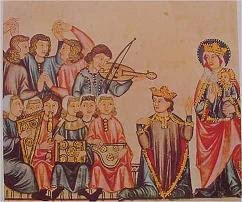
Troubadour entertaining aristocracy.

From 14th to 15th century, during a transition between Medieval Era and Renaissance, the movement of HUMANISM emerged in Italy to the rest of Europe. Historically, feudalism³ was in its period of decay. The Black Death and the Hundred Year’s War between England and France decimated great part of Europe’s population. There were not much people to keep feudal properties safe from impostors, not even more vassals­4. The emergence of a new social class, the merchants, demanded a change in the laws to come and go between properties, since the feudal laws didn’t allow the circulation of any person from one land to another. This way, the feudal Lords disappeared, giving space to a new way of government: the Monarchy. Feudal properties are now grouped into a monarchy, and the Right to come and go facilitates trades of any kind. 

In consequence of the church crisis, the art from Humanism gives valuation to men, who are the center of everything instead of God. Universities, dominated by the church, now undergoes a makeover, allowing the critical thinking instead of only theologies studies. In Portugal, Fernão Lopes is named chronicler of Torre do Tombo, where all the historic documents were storage. His job was to write chronicles about the deeds of kings. At the same time, Sá de Miranda comes back from Italy and brings to Portugal the new aesthetic. Humanism, then, is marked by the decay of poetry and the evolution of prose, not only by the chronicles, but also by production of plays such as The Divine Comedy. The most important authors from this period are Dante Alighieri and Miguel de Cervantes.

Later on, from early 14th through the 16th century, RENAISSANCE was the new artistic movement in vogue. It started in Italy, from where it was spread all over Europe. In those days, several burghers’ sons begun to attend universities, getting in touch with the classic culture. At the same time, a religious crises led by Lutero started a manifestation of questions about God. This way, one of the characteristics of the artistic production of that time was anthropocentrism, with a strong idealization of pagan gods and so the classic mythology, which writing registry was spread thanks to the invention of press. Followed by all these factors, one of the principal characteristic of this movement is the rationalism versus emotionalism and religiousness. The expansion of merchant activities opened space for Mercantilism, so that the great navigations allowed exploration and a different point of view of the world. The “discovery” of the New World is one of the remarkable happenings of that time.  Some of its important authors are Luis Vaz de Camões and Francisco Sá de Miranda.     
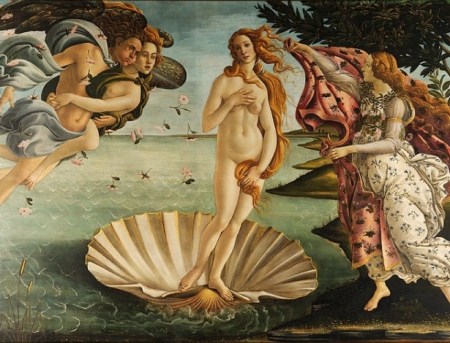
The Birth of Venus by Sandro Botticelli.


Contrary to the Renaissance, in which there were no space for emotionalism, ROMANTICISM, as the name already says, emphasized the emotions rather than rationalism. It was an artistic movement that started in the 19th century and had different generations through Europe, having several characteristics, such as the Gothic, darkness of emotions, depression, and, specially, the individual subjectivity. The German author Johann Wolfgang Von Goethe wrote the novel The Sorrows of Young Werther, a romantic love story with a drastic ending, and this work was spread through Europe. As the bohemian lovers read it, it caused a mass suicide. Let’s explain this: literature was the way of entertainment of that time: no TV, no cellphones, no iPads… In this sense, it was also a way to inspire the youth in their way of living and creating art. That said, the trama of Goethe’s novel was so real, with such a disturbing tone and morbid end, that caused commotion among them, who identified themselves to the character Werther, deciding to follow his drastic ending. This movement of mass suicide in real life and in literature was so common that it got a name: Sturm und Drang (Storm and Stress in English), a period in which man finds himself as self-destructive and sinful. The English author George Gordon Byron emphasized the Sturm und Drang in his poems, which are famous all over the world. Another important type of production in Romanticism is the fantastic literature, which Edgar Allan Poe is an essential author. Its most important characteristics are the nature of darkness and mysterious forces. Other important authors are Victor Hugo, Bram Stoker, Nathaniel Hawthorne and Camilo Castelo Branco.
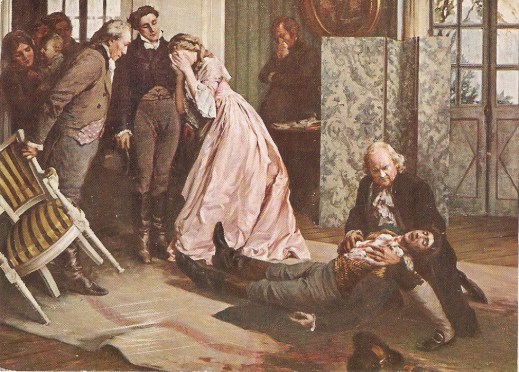
The Death of Werther by Baude.

In 1857, Gustave Flaubert, a french author, published his novel Madame Bovary, which came to break down Romanticism completely and to start a new artistic movement: REALISM. There were no more space for romantic stories; on the contrary, the love stories were seem as a joke and a bad example for society. The faithful representation of reality, the psychological analyzes of characters and details of narration are some of its principal characteristics. Some of the most important authors from Realism are Honoré de Balzac, Leo Tolstoy, Eça de Queiroz and Machado de Assis.

As an extension of Realism, NATURALISM came from France in the 19th century to portray society in a very objective way, using elements of biology to comprehend human behavior. Pessimism, again, is one of its principal characteristics, followed by Scientism, in the sense that everything had to be explained by the eye of science. Its common themes are misery, racism, prejudice, prostitution, crimes, sexual perversions and adultery, and all of it, as human behavior and origins, is explained biologically. This artistic movement is extremely influenced by Charles Darwin’s theory of evolution. Some important authors of Naturalism are Émile Zola, Aluísio Azevedo and Thomas Hardy.

In the Fin de Sècle in France, SYMBOLISM reacted against rationalism, materialism and scientism from the previous movement. The literary artists applied a language in their work that could “suggest” reality instead of the obvious way of realism in the past. To do so, they used symbols, images, metaphors and synesthesia (figure of speech) to basically invite the reader to analyze those elements and to put all the information together in other to achieve its meaning. Some of its important authors are Arthur Rimbaud, Paul Valéry and Charles Baudelaire.

Other artistic movements happened during Realism, some of them, as we already said before, its extension. MODERNISM came afterwords, in early 20th century, and had completely different characteristics, such as formal innovation, reaction to science and technology and encompassing primitivism. This is a very important and rich period of artistic production, which we will discuss further before the analyzes of Macunaíma, as Mário de Andrade, its author, is one of the representative of Modernism in Brazil. Some of the principal authors of this movement are Ezra Pound, T. S. Eliot, James Joyce, Fernando Pessoa and Mário de Andrade.

In late 20th century, POSTMODERNISM was also a period of rich production. After both World War, the world experiment different changes, specially psychological by the fear of another war. We have discussed a little about this when we talked about Virginia Woolf’s Stream of consciousness, one of the characteristics of Postmodernism as well as the fragmentation and paradox. Some of its important authors are Jorge Luis Borges, Samuel Beckett and João Cabral de Melo Neto.

As we can see, there are lots of literary movements around the wold, and we just made a simple explanation of a few of them. The importance of its knowledge is that, by so, we can comprehend the meaning of the literary work. For example, why some works don’t have a regular punctuation? Maybe it was because of the artist’s style; maybe it was because of the time the artist lived. In whichever way, the answer is out there, you just have to catch it through a lot of reading.

We hope you enjoy today’s reading. Next week we will make a reading of Morphology of The Folktale by Vladimir Propp, the semiotics theory we will apply to our first literary analyzes. 

Literature has a immense history and a past full of incredible work. Could you tell us your favorite literary movement and why? 


GOOD TO KNOW


SEMANTICS – LITERAL AND FIGURE OF SPEECH

When we speak to someone in a literal way we intent that our message is transmitted in a very clear way. LITERAL LANGUAGE, then, is composed by words which use are according to their exactly meaning or definition. There is no way a person wouldn’t understand the message, unless the words in use in the context of communication are actually not common or are too formal. In opposition, when we want to communicate something but we don’t want the message to be so direct and clear, we use a technique called FIGURE OF SPEECH, which are commonly used in poems and lyrics. In literature, it is one of its main tools in the sense that the words are not used according to their exactly meaning or definition, but are deviated from their meaning to be equated, compared or associated with other normally unrelated words or meanings. Our interest, therefore, is to understand some figures of speech so that we can identify them during our readings. Below are a few examples:

  • Simile: comparison of two things.

Example: Elderly American ladies leaning on their canes listed toward me like towers of pisa (Lolita by Vladimir Nabokob).

  • Metaphor: implicit, implied or hidden comparison between two unrelated things that share some common characteristics.

Example

ROMEO: But, soft! What light through yonder window breaks?

          It is the east, and Julie tis the sun.

          (Romeo and Juliet by William Shakespeare)

  • Synesthesia: a sensation combined by another to give one only impression.

Example: Back to the region where the sun is silent. (The Devine Comedy by Dante Alighieri)

  • Onomatopeia: a word designed to imitate a sound.

Examples: Splash (for water), moo (cow), meow (cat).

  • Personification: human characteristics attributed to inanimate objects or abstract notions.

Example:

Have you got a brook in your little heart,
Where bashful flowers blow,
And blushing birds go down to drink,
And shadows tremble so?

(Have You Got A Brook In Your Little Heart by Emily Elizabeth Dickinson.)

  • Oxymoron: pair o f opposite or contradictory terms used together for emphasis.

Example:

I will bestow him, and will answer well
The death I gave him. So, again, good night.
I must be cruel, only to be kind:
Thus bad begins and worse remains behind.
One word more, good lady.

(Hamlet by William Shakespeare)

  • Paradox: self-contradictory, unreasonable or illogical statement or proposition.

Example:

I must be cruel to be kind.

(Hamlet by William Shakespeare.)

  • Hyperbole: extravagante or exaggerated statement to express strong feelings.

Example:

I had to wait in the station for ten days-an eternity.

(The Heart of Darkness by Joseph Conrad)


Notes:

  1. A narration in the 1st person of the discourse is made by a character. In this particular case, it is the main character who narrates its own story, showing its psychological emotions.
  2. Iberian Peninsula at that time aggregated the territoris of Portugal and Galicia.
  3. Feudalism was a period of Medieval Europe in which a relationship between a Feudal Lord (a man who is the owner of a big piece of land, the nobility), the clergy and the peasantry – the three social classes of that time – was necessary in order to acomplish their obligations of war. 
  4. Vassal was, in the Feudalism era, a person who had obligations to a Feudal Lord such as military support, shelter when needed and protection. A vassal had to sworn loyalty to the lord and was basically tied in this alliance forever.


Bibliography:

Alighieri, Dante. (2015). The Divine Comedy. Quarto Group: New York.

Dickinson, Emily Elizabeth. (2013) Have You Got A Brook In Your Little Heart. Delphi Classics.

Fortarel, Jô. (2008) Literatura em Língua Portuguesa: Enciclopédia do Estudante. Moderna: São Paulo.

Nabokob, Vladimir. (2010) Lolita. Knopf Doubleday Publishing Group: New York.

Nicola, José de. (1990) Literatura Portuguesa da Idade Média a Fernando Pessoa. Scipione: São Paulo.

____ (1985) Literatura Brasileira das Origens aos Nossos Dias. Scipione: São Paulo.

Shakespeare, William. (2000) Romeo and Juliet. Wordsworth Editions: United Kingdom. 

____ (1988) Hamlet. Bantam Books: New York.


Literatura – Parte 1

Definição

Quem é você em um museu de arte? Aquele que possui grande conhecimento acerca das obras artísticas nele em exibição ou aquele que nada sabe sobre elas? Se você é O primeiro, terá mais chances de apreciar o que está vendo e não se apressará ao analisar cada pedacinho da obra de forma que possa ter sua própria experiência de interpretação. Dessa forma, poderá fazer uma viagem, e a obra será toda sua, com uma mensagem especialmente feita para você. Ao mesmo tempo, pensará nos dados biográficos do artista enquanto vivo e o período histórico que se insere, e até mesmo quererá saber mais informações para preencher os pedaços incompletos de dados que você deve ter armazenados em seu cérebro. Se você é o segundo, no entanto, a experiência não será a mesma daquele camarada que chamamos anteriormente de “O primeiro”. Não se preocupe, nem tudo está perdido para você SE realmente quiser apreciar o que vê, uma vez que a arte é para todos a apreciarem da maneira que quiserem para que, ao final, haja satisfação.

O mesmo acontece com a literatura, que é outra forma de expressão artística. Se você ler uma obra literária, mas não entender seu significado, não se assuste. Quando um autor escreve uma estória que não é fácil de compreender, ele não está tentando ser chato, mas sim criar arte. E o bom lado disso tudo é que, uma vez que a estória foi publicada, ela não é mais sua “criança”. Qualquer pessoa pode lê-la e toma-la da forma que quiser. Nós temos permissão para gostar, desgostar e de dar mensagem a ela através de nossa leitura. Se você ler Metamorfose de Kafka e quer dizer que a personagem principal se transforma em uma barata, você pode fazer isso. Mesmo que estivesse vivo, Kafka não teria o direito de reclamar. Se o que você lê é uma boa obra literária, você deveria lê-la mais de uma vez, pois, acredite, você terá uma nova estória a cada leitura. Lembre-se, o objetivo principal de Oticrature é dar todo o suporte necessário para os leitores interessados apreciarem uma boa leitura, então mesmo que você seja o segundo camarada no museu de arte, você ainda pode gostar do que lê com alguma ajuda.

Nós falamos um pouco sobre pessoas no museu de arte e outras coisas mais, mas nós ainda temos de responder uma questão que provavelmente está saltando de sua cabeça. O que significa literatura? Bem, vamos começar com uma definição de dicionário:

Li.te.ra.tu.ra

  1. Livros, peças de teatro, poemas etc que pessoas pensar ser importantes e boas: Ele tem lido muitas das obras literárias mais importantes. | Literatura italiana.
  2. Todos os livros, artigos etc sobre um determinado assunto: literatura sobre a história da ciência | na literatura. Vários casos de envenenamento por mercúrio foram registrados na literatura.
  3. Informação impressa produzida por pessoas que querem lhe vender algo ou lhe falar sobre algo: literatura de vendas. (Quirk, 2006, tradução nossa)


Está claro, portanto, que estamos nos referindo à primeira definição: livros, peças de teatro, poemas, etc., que pessoas pensam ser importantes e bons. No entanto, quem são estas pessoas que pensam que alguns livros, peças de teatro, poemas, etc., são importantes e bons? E por que eles são importantes e bons? E por que esta definição é tão genérica? Bem, não podemos responder à última, mas continue lendo, pois iremos responder às outras.

Vamos supor que um amigo seu te diga “Acabei de ler um romance lindo. É tão incrível! Você deve lê-lo”. Qual é o ponto de vista de seu amigo acerca do romance? Que é importante – “Você deve lê-lo” – e bom – “É tão incrível!”. De acordo com aquela primeira definição do dicionário, o livro que seu amigo leu é uma obra literária, certo? Você segue em frente com a discussão e pergunta ao seu amigo que livro é este e ele diz “É Um Amor para Recordar, de Nicholas Sparks”. Agora, este romance é ou não é literatura?

A resposta é não, mas isso nada tem a ver com o fato de o romance ser bom ou não – “bom” é uma questão de opinião, ou seja, é muito subjetivo. O motivo é que Um Amor para Recordar não tem literariedade, que é elemento dominante em uma obra literária.

Definir o significado de literatura, como percebemos, não é tarefa fácil. Muitas pessoas já tentaram, alguns dicionários não têm elementos suficientes para descrevê-la, e estes são provavelmente os motivos pelos quais muitas pessoas se confundem a este respeito.

De acordo com o que já discutimos até agora, podemos deduzir que literatura:

  1. é uma arte;
  2. é composta de palavras, ou seja, sua estrutura é textual;
  3. tem literariedade como elemento dominante.

Arte vem da palavra em latim artem, que significa trabalho artístico, habilidades práticas, atividade comercial, profissão. Aristóteles dizia que a arte imita a vida. Bergson e Proust a via como a exacerbação da condição irregular inerente na realidade. Nós sabemos, no entanto, que é uma criação de qualquer tipo (filmes, pinturas, esculturas, música…) produzida pela imaginação humana e que tem a ver com a experiência de vida, pois é uma expressão e interpretação do mundo que nos rodeia. O artista tem habilidades, ou seja, princípios estéticos, que o ajudarão a expressar a beleza de sua criação em sua totalidade. Para alcançar estes princípios estéticos, o artista deve conhecer seu material de trabalho, que pode ser as cores (ex. para pinturas), palavras (ex. para literatura), imagens (ex. para filmes), sons (ex. para música) e muito mais, a fim de que as potencialidades de todos estes instrumentos possam ser extraídas e usadas de forma atrativa e, assim, criar a arte. Uma obra de arte tem mais do que um significado comum e pretende impactar a emoção das pessoas através da combinação de elementos de forma simples ou complexa.

Literatura é a arte feita através de palavras. O autor que a cria sabe o que pode ser feito com o seu instrumento de trabalho e o que pode ser resultado dele: rimas podem trazer musicalidade a um poema, metáforas podem expressar emoções implícitas… O resultado da “lapidação” da palavra são os princípios estéticos do artista, que trazem para a arte um toque especial. Vamos utilizar este lindo soneto de Luís Vaz de Camões, um dos autores clássicos mais importantes de Portugal, como exemplo:

Amor é um fogo que arde sem se ver; 
É ferida que dói, e não se sente; 
É um contentamento descontente; 
É dor que desatina sem doer. 

É um não querer mais que bem querer; 
É um andar solitário entre a gente; 
É nunca contentar-se e contente; 
É um cuidar que ganha em se perder; 

É querer estar preso por vontade; 
É servir a quem vence, o vencedor; 
É ter com quem nos mata, lealdade. 

Mas como causar pode seu favor 
Nos corações humanos amizade, 
Se tão contrário a si é o mesmo Amor?¹

O que é o amor? Qualquer pessoa pode tentar responder a esta pergunta, mas não será tarefa fácil. Camões, neste soneto, está tentando fazê-lo, e utiliza-se de muitas metáforas para explicar o que não tem explicação exata. O amor queima como o fogo, nos faz sofrer, ao mesmo tempo em que nos trás alegria.

Finalmente, devemos dizer que o element mais importante de uma obra literária é a sua literariedade. Sobre isso, diz Nöth:

Através de uma perspectiva pragmática, literariedade é analisada com referência à intenção do autor e à forma de interpretação do texto feita pelo leitor. […] Portanto, o texto literário é polifuncional e permite referência a vários contextos extratextuais. […] Uma caracterização positiva da pragmática literária é dada por Segre: Literatura “mantém seu potencial comunicativo também fora do contexto pragmático: no texto literário, uma introjeção de referências contextuais ocorrem, de forma que o leitor possa deduzi-los a partir do próprio texto” (1979b:35) (Nöth, 1990, p. 350, tradução nossa). 

Literariedade é, então, a estrutura de significação, uma linguagem especial que dá o estatuto de polissemia à literatura. Já discutimos alguns destes elementos (rima, figuras de linguagem…) e o que eles podem significar no contexto de uma obra literária. Em outras palavras, qualquer pessoa pode escrever uma estória, mas nem todos conseguirão alcançar a atenção do leitor; isto dependeria de como a estória está sendo contada. Se utilizarmos literariedade, então teremos muito mais do que uma simples estória: teremos arte.

É importante termos em mente que o estatuto de literature pode mudar com o passer do tempo, assim como aponta Nöth:

 Literatura não é uma categoria estática. O predicado da literariedade caracteriza avaliação estética, e tais avaliações podem mudar de acordo com as culturas e épocas. Originalmente, o que não era texto literário (ex. religioso) adquiriu, após séculos, o estatuto de literatura, ao mesmo tempo em que textos originalmente literários podem sofrer perda de sua literariedade (Lotman 1970: 287-88). Mudanças especialmente radicais na evolução da literatura têm sido demonstradas pela literatura moderna de vanguarda, em que, entre elas, receitas culinárias têm sido apontadas com estatuto de literariedade (cf. Nöth 1977a; 1978a) […] (p. 353, tradução nossa).

Nós aprendemos que não é fácil explicar o que de fato literature é. Sabemos como certeza de que é uma das coisas mais importantes para a maioria das pessoas. Sobre isso, Sutherland tem sábias palavras:

Para a maioria das pessoas mais atenciosas, literatura desempenhará um papel muito importante em suas vidas. Nós aprendemos muitas coisas em casa, na escola, com os amigos e da boca de pessoas mais sábias e inteligentes do que nós mesmos. Mas a maioria das coisas mais valiosas que sabemos vem da literatura que lemos. Se nós lemos bem, nos encontraremos em uma relação de conversa com as mentes mais criativas de nosso tempo e do passado. Tempo gasto lendo literatura é sempre tempo bem gasto. Não deixe ninguém te dizer o contrário (Sutherland, 2013, p. 2, tradução nossa). 

Vamos voltar àquelas duas questões do início: quem são as pessoas que pensam que alguns livros, peças de teatro, poemas, etc., são importantes e bons? E por que eles pensam que são importantes e bons? Bem, genericamente, qualquer pessoa pode dizer que são importantes e bons – como já dissemos, é uma simples questão de opinião. No entanto, quando estamos discutindo literatura, todos nós também podemos dizê-lo, contanto que nós possuímos alguma bagagem teórica que suporte nossas opiniões, como a semiótica, pois devemos ter uma razão para dizer que uma obra é, de fato, literária. Devemos encontrar a literariedade, e as teorias literárias nos ajudarão a encontra-la.

Esperamos que este pequeno “bate-papo” sobre a arte da palavra tenha sido, para você, útil e clara. Nosso próximo artigo discutirá elementos da literatura, assim como suas origens, períodos, princípios estéticos e assim por diante. Antes disso, você poderia nos dizer qual foi a lição de vida que você aprendeu através da literatura?   


Notas:

  1. 1. extraído de: http://www.citador.pt/poemas/amor-e-um-fogo-que-arde-sem-se-ver-luis-vaz-de-camoes


Bibliografia:

Nöth, Winfried. (1990). Handbook of Semiotics. Indiana University Press: Bloomington and Indianapolis.

Quirk, Lord. (2006). Longman Dictionary of Contemporary English. Pearson Longman: England.

Sartre, Jean-Paul. (1988). What is Literature? And Other Essays. Harvard University Press.

Sutherland, John. (2013). A Little History About Literature. Yale University Press.


Image

Literature – Part 1


Definition

Who are you in an art museum? The one who already has a good amount of information about the artistic pieces there in exhibition or the one who doesn’t know anything about it? If you are The first one, you are more likely to appreciate what you see and take your time to “analyze” every inch of it to have your own experience of interpretation. You might have a “trip”, then, and the art will be all yours, with a message specially made for you. At the same time, you will also think of the biographical aspects of the artist’s life and the historical period in which he/she lived and even want to find out more information to fill out the incomplete pieces of data you should have storage in your brain. If you are the second one, though, the experience won’t be the same as that buddy who we called “The first one”. Don’t worry, not everything is lost for you IF you truly want to enjoy what you see, as the art is free for everyone to take it the way they want in order to have an appreciation at the end.

The same happens with literature, which is another form of art expression. If you read a literary work but don’t understand its meaning, don’t be afraid. When the author writes a story that is not easy to comprehend, he/she is not trying to be mean but create art. And the good thing about it is that once it is published, it is not the author’s “child” anymore. Anybody can read it and take it the way they want. We are allowed to like it, dislike it and give meaning to it through our reading. If you read Metamorphosis by Kafka and want to say the main character became a cockroach, you can do so. Even if he was alive, Kafka would not be right to complain about it. If what you are reading is a good literary piece, you should read it more than once because, believe me, you would have a new story every single time. Remember, the main goal of Oticrature is to give all the necessary support to the interested readers to enjoy a good reading, so even if you are the second buddy at the art museum, you can still enjoy what you read with some help.

We talked a little bit about people at art museums and some other things, but we still have to answer a question that might be popping out of your head. What does literature mean? Well, let’s start with a dictionary definition:

Lit.e.ra.ture

  1. books, plays, poems etc that people think are important and good: He has read many of the major works of literature. | Italian literature
  2. all the books, articles, etc on a particular subject: [+on] literature on the history science | in the literature Several cases of mercury poisoning have been recorded in the literature.
  3. printed information produced by people who want to sell you something or tell you about something: sales literature

It is clear, therefore, that we are talking about the first definition: books, plays, poems etc that people think are important and good […]. However, who are these people who think some books, plays, poems etc. are important and good? And why do they think they are important and good? And why is this definition so generic? Well, we can’t answer the last one, but keep reading, as we are going to answer the other ones.

Let’s say a friend of yours comes to you and says “I just read a beautiful novel. It’s just incredible! You must read it!”. What is your friend’s point of view about the novel? That it is important – “[…] you must read it!” – and good – “It is just incredible!”. According to the first definition we extracted from a dictionary, the book your friend read is a literary work, right? You go on and ask your friend what book is that and he/she says “It’s A Walk to Remember by Nicholas Sparks”. Now, is this novel a literary work?

The answer is no, and it’s not because the novel is not good – “good” is a matter of opinion, that is, very subjective. The reason is that A Walk to Remember doesn’t have literariness, which is the dominant element in a literary work.

To define literature, as we notice, is not an easy job. Lots of people already tried, some dictionaries don’t have enough elements to describe it. That’s probably why most people are confused about this matter.

According to what we have discussed so far, we can infer that literature:

  1. is an art;
  2. is composed by words, that is, its structure is textual;
  3. has literariness as dominant element.

Art comes from the Latin word artem, which means work of art, practical skill, business, craft. Aristoteles was used to say that art is imitation of life. Bergson and Proust saw it as the exacerbation of atypical condition inherent in reality. We know, therefore, that it is a creation of any kind (movies, paintings, sculptures, music…) produced by human’s imagination and has to do with experience of life as it is an expression and interpretation of the world around us. The artist has skills, that is, his/her own aesthetic principles, which will help him/her to express the beauty of the creation in its totality. To achieve the aesthetic principles, the artist has to know his/her material of work, which can be colors (e.g. for paintings), words (e.g. for literature), images (e.g. for movies), sounds (e.g. for music) and much more so the potentialities of all these tools can be extracted and used in an attractive way so the art can be created. A piece of art has more than ordinary significance and intend to impact people’s emotions by a simple or complex combination of elements.

Literature is art made by words. The author who is creating it knows what can be done with them and resulted by them: rimes can bring musicality to a poem, metaphor can express implicit emotions… The result of the “stoning” of the word are the artist’s aesthetic principles, which will bring to the art a special touch. Let’s take this beautiful sonnet by Luís Vaz de Camões, one of the most important classic authors from Portugal, as an example:      

Love is a fire that burns unseen, 
a wound that aches yet isn’t felt,
an always discontent contentment,
a pain that rages without hurting,

a longing for nothing but to long,
a loneliness in the midst of people, 
a never feeling pleased when pleased, 
a passion that gains when lost in thought.

It’s being enslaved of your own free will;
it’s counting your defeat a victory;
it’s staying loyal to your killer. 

But if it’s so self-contradictory,
how can Love, when Love chooses,
bring human hearts into sympathy?¹

What is love? Everybody can try to explain it, but it won’t be an easy job. Camões is trying to do so in his sonnet and uses lots of metaphors to explain what has no exact explanation. Love burns like a fire, makes us suffer, but at the same time it can bring us joy.

Finally, we must say that the most important element of a literary work is its literariness. About that, Nöth says:   

From a pragmatic perspective, literariness is analyzed with reference to the author’s intention and the reader’s way of interpreting the text. […] Accordingly, the literary text is polyfunctional and permits reference to several extratextual contexts. […] A positive characterization of the pragmatics of literature is given by Segre: Literature “maintains its communicative potential also outside of its pragmatic context: in the literary text an introjection of contextual referents occurs, so that the reader can derive these from the text itself” (1979b:35) (Nöth, 1990, p. 350).

Literariness is, then, the structure of meanings, a special language which gives the status of polysemy to literature. We already discussed some of these elements (rime, figure of languages…) and what they can mean in the context of the literary work. In other words, anybody can write a story, but not everybody will get the reader’s attention, that would depend on how we tell the story. If we use literariness, then we have more than a simple story: we have art.

It is important to have in mind that the status of literature can change with the pass of the time, as Nöth points out:

Literature is not a static category. The predicate of literariness characterizes aesthetic evaluation, and such evaluations may change with cultures and times. Originally nonliterary (e.g., religious) texts have after centuries been evaluated as literary, and originally literary texts may lose their literariness with time (Lotman 1970: 287-88). Especially radical changes of literary evaluation have been demonstrated by the modern literary avant-garde, where among other texts, cooking recipes have been raised to the status of literariness (cf. Nöth 1977a; 1978a) […] (p. 353).

We learned that it is not easy to explain the meaning of literature. We do know for sure that it is one of the most important things for most of people. Sutherland has wise words about it:

For most thoughtful people, literature will play a big part in their lives. We learn a lot of things at home, at school, from friends, and from the mouths of people wiser and cleverer than ourselves. But many of the most valuable things we know come from the literature we have read. If we read well, we find ourselves in a conversational relationship with the most creative minds of our own time and of the past. Time spent reading literature is always time well spent. Let no one tell you otherwise (Sutherland, 2013, p. 2).

Let’s go back to those two questions from the beginning: who are the people who think some books, plays, poems etc. are important and good? And why do they think they are important and good? Well, if we are talking generally, anybody can say they are important and good – as we said before, that is a fact of opinion. However, when we talk about literature, we all can also do so as long as we have some literary theories to support our opinions, like semiotics, as we must have a reason to say that specific work is, in fact, literature. We must find the literariness, and literary theories will help us find it.

We hope this little “chat” about the art of word was for you helpful and clear. Our next post will discuss elements of literature, as well as its origins, periods, aesthetic principles and so on. Before that, could you tell us a lesson for life you learn through literature?   

Notes:

  1. translation from http://www.poetryinternationalweb.net/pi/site/poem/item/8436/auto/Luis-Vaz-de-Camoes/Love-is-a-fire-that-burns-unseen-.-.-


Bibliography:

Nöth, Winfried. (1990). Handbook of Semiotics. Indiana University Press: Bloomington and Indianapolis.

Quirk, Lord. (2006). Longman Dictionary of Contemporary English (2006). Pearson Longman: England.

Sartre, Jean-Paul. (1988). What is Literature? And Other Essays. Harvard University Press.

Sutherland, John. (2013). A Little History About Literature. Yale University Press.


First blog post

Semiotics


To star with a simple definition – as the subject is not, even by its name, far from complexity –, semiotics is the theory of signs. Sign is an essential element in the communication process, lying around in different contexts by the various aspects of human knowledge. Semiotics comes from the Greek word semeiotikos, the interpreter of signs. As we can see, the importance of signs comes from a long time ago, when the Greeks were used to interpret natural events, like the weather, as interference of the gods on the future of the species, and it is still extremely relevant for human communication with all its forms of expressions.

Signs can be anything. They are everywhere and are amazingly diverse. As a quick example, the wall painting of Oticrature¹, the traffic lights, novels, films and food are considered signs, and it is important for us to understand their meaning, what the signs as vehicle of messages are trying to communicate. Taking the lights on the street as basic objects of analyzes, their meaning is pretty obvious for human beings because of our knowledge about driving and walking on the street. Since our childhood, we learn the meaning of all the color on a traffic light: the green color means GO, the yellow color means PROCEED WITH CATION and the red color means STOP. Therefore, we are supposed to know all about traffic lights by the time we decide to take our driver’s license. It is obvious that we have to learn all this information in order to keep us and people around us safe from harm in the traffic scenario. In this sense, traffic lights are an aspect of human knowledge which has a universal meaning.

It seems pretty easy to understand the diverse representation and meaning of the signs, but although some of them are internationally recognized, as the one we just discussed, others are only understood within a particular group or context. That’s where our interest of study takes place.

After all those considerations, let’s move towards our objective, that is, the kind of sign that will “break our heads”, make us wonder why isn’t the sign to analyze so much easier, like that one of the traffic lights. Well, we will see that, even though “breaking heads” in a literary way is not really cool, the “breaking heads” in a nonliterary way is a lot of fun.

There are several theories of semiotics out there to study different types of signs in different structures of meaning, like visual arts and linguistics. We are, though, selecting one, which is among the text: literature, which also includes poetry, drama and narrative. Like any other semiotics, the literary one has its root in linguistics, and, at some point, we’ll be discussing a few elements of linguistics related to some aspects of literary semiotics. However, we won’t take to much time discussing linguistics, as it is a vast campus of study. The purpose of this introduction is to make the understanding of literary semiotics clear so we can easily apply it in our analysis.

We said earlier that a sign has a Signifier and a Signified. While the first one is “something” that has a meaning, the second one is the meaning that that “something” has. In an easy way:

Signifier + Signified = Sign

The traffic lights are the signifier and the meaning of it (to keep us safe from harm) is the signified.

It is important for us to understand signifier and signified – two linguistic elements – as we will be using these terms while discussing semiotics and literature.

Signs can be shaped, communicated and understood in different ways. In literary semiotics, the channel of meaning is the book. In order to understand the message transmitted by a book, we need to know its structure, that is, textual. Then, we can discuss all its ways of meaning (literal, analogical, metaphorical), the sources of meaning (cultural), context of meaning (historical…) and types of meaning (cognitive, non-cognitive). If we can go through all these elements, we are more likely to have an understanding of the signifier. That’s why, in literature analyzes, we try to extract information about the historical moment in which the literary work was written, who was the author and his/her influences in life, the artistic movements in fashion, and any other elements that can contribute in a better understanding of the signifier in analyzes.

In a literary work, we have the elements of the story in a surface structure, which means they are clear to the readers: characters, themes, plot, genre, style and so on. We also have elements of the story in a deep structure, that is, it may not be as apparent as we expect. These elements are important in our analysis in a way that the surface structure will help us to understand the deep structure. The difference between a book for merely entertainment and a book of superior academic value is that, while in the first one you don’t have to make an analysis of it for the narrator gives you all the information you need in order to follow the sequence of actions, the second gives you a few tips through the narrations as puzzle pieces, in which the reader has to collect them, analyses them and put them in a logical sequence to give the fiction a meaning.

HALL points the following:

[…] The deep structure is important because by accessing it we can reveal the underlying meaning and importance of what is being told to us. For instance, the deep structure might be there to persuade the reader of the value of (or, in some cases, to question the value of) such things as traditional values, dominant political ideologies, prevailing ethical systems, preferred social attitudes, established cultural norms, current forms of knowledge, and existing institutional practices. For example, it might be argued that, while Jane Austen wishes to defend certain traditional ideas about romantic love in Pride and Prejudice, Gustave Flaubert seeks to challenge them in Madame Bovary (2012, p. 12-13).

There are several studies about textual semiotics, in which structuralism is among them. For our first analyzes, we will apply the structuralism of Vladimir Propp from his “Morphology of the Folktale”, in which he analyzes Russian’s folk tales and identifies common themes within them. Our first literary work for discussion will be Macunaíma, a Brazilian novel by the author Mário de Andrade. We will, then, try to observe in which way Macunaíma’s structure is close to that of a folktale and what is its message to the readers.

We have discussed a few ideas about semiotics, which are very little pieces of information from a vast field of study. But the most important thing is that semiotics, as our tool, will help us to have our own perspective of what a specific signifier means. There are lots of studies about Pride and Prejudice, for example, but each one has its own ways of interpretation. We are free to interpret, as long as we can proof our point of view through the elements of meaning we just discussed. So let’s get ready for our first reading: Macunaíma, by Mário de Andrade.

Where to find it: amazon.com (unfortunately, there is only one edition of it in English, which was translated by E. A. Goodland and published by Randm House in 1984.)

Let’s get into this adventure together. Next discussion will be about literature, definition and importance to us. Could you tell me in which way literature has a role in your life?


Note:

  1. A Leitura, by Almeida Junior, 1892.


Bibliography

Barthes, Roland. (1964). Elements of Semiology. Hill and Wang: New York. 

Cobley, Paul & Jansz, Litza. (2004). Introducing Semiotics. Icon Books: US. 

Hall, Sean. (2012). This Means This, This Means That: A User’s Guide to Semiotics. London: Laurence Ling.

Nöth, Winfried. (1990). Handbook of Semiotics. Indiana University Press: Bloomington and Indianapolis.